Monkey Island Image Converter gets an update

Every so often I get bug reports for some of my more niche programs, these are always gratefully received. This week brought news that Monkey Island Image Converter had a problem with selecting the destination folder, only folders on the desktop were selectable.

This program is my tool that lets you replace the images in the special editions of Monkey Island 1 and 2. Its been used to make a hair patch to make MI1 Guybrush less of a crime and to fix some of the wonky backgrounds. Its been 15 years since the last release of the program and it turns out that at some point I added code for the Xbox 360 versions of the games so this new release adds support for that platform too.

Download it here.

SCUMM Versions

This isn’t so much an article as it is…a link.

This is my spreadsheet that covers 400+ different SCUMM games and demos, listing their interpreter and resource file versions along with embedded dates and times. It was created using my SCUMM Info Extractor tool.

View it here.

Enabling Debug Mode in Tales of Monkey Island and other Telltale games

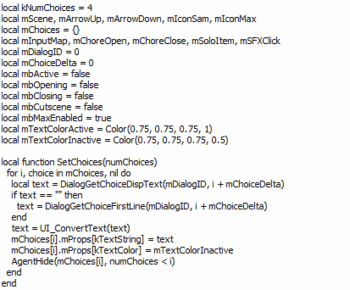
I wrote this article for Mojo. It shows the process of looking through the game scripts to find out how to enable debug mode. In part two it looks at how to edit the scripts and put them back into the game.

It includes files that you can download and add to your game to enable debug mode. It also has downloads for my toolset for editing the scripts – these lets you edit other Telltale games.

Read it here.

The Monkey Island 2 talkie prototype (and windex)

Over at Mixnmojo we were given a copy of a talkie prototype of Monkey Island 2. It was from when the company was testing out adding speech to their games.

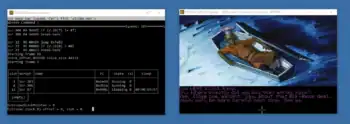
In this article I look through the prototype and examine the files. I then go into a deep dive on windex – Lucasart’s debugger and how to use it with the classic dual-monitor setup.

Part 1 of the article has the download link for the prototype.

Read it here.

Telltale Explorer fixed script decompiling for older games

I’ve just released a new version of Telltale Explorer that fixes a longstanding issue – lua scripts in the older games couldn’t be decompiled. This affected most the games released before Sam and Max: The Devil’s Playhouse. It’s now fixed and the scripts in every Telltale and Skunkape game can be decompiled and viewed.

This wasn’t an issue that I was planning to revisit but I was writing an article for Mojo that involved looking at the scripts in Telltale games. I’ve had working script decompiling for post-Devil’s Playhouse games for a long time with modified lua 5.1 and 5.2 decompilers, but the oldest games used lua 5.0 and I just couldn’t get it working. While writing the article I got sidetracked into trying to fix it once and for all and after a lot of hacking, swearing and failure this 18 year old bug was finally squashed. For posterity and myself when I inevitably forget, the changes made to lua 5.0 by Telltale were: the opcodes were shuffled, maxstack was changed to 300 and it was built for floats rather than doubles.

Download it here.

Telltale, Skunkape tools updated

With the release of Skunkape’s wonderful remaster of Sam and Max The Devil’s Playhouse I’ve updated 3 of my programs. Telltale Explorer, Music Extractor and Speech Extractor have all been updated to support it.

This is a slightly bittersweet update as Devil’s Playhouse will probably be the last game ever released using the old Telltale engine. Skunkape did a brilliant job on the Sam and Max remasters and I’d love them to do the same with Tales of Monkey Island but it seems unlikely.

Download Telltale Music Extractor here, Telltale Speech Extractor here and Telltale Explorer here.

After 14 years EMI Background Viewer is updated

It turns out that EMI Background Viewer had a bug lurking since its last release in 2010. Viewing backgrounds from the PC version was fine, but those from the PS2 didn’t work. The internet can now breathe a collective sigh of relief as the bug has been fixed and the terrible tragedy of a 14 year period in which no-one could view EMI PS2 backgrounds comes to an end.

Download it here.

I also recently updated Double Fine Explorer to add support for Kinect Party. It can be downloaded here.

Dinky and Grim Bugfixes

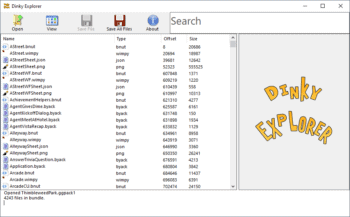
Dinky Explorer screenshot

A few bugfix updates today. Dinky Explorer gets a fix for a rogue 0 byte file in Thimbleweed Park that caused a crash. The venerable Grim Fandango Launcher and Setup programs have been updated to fix a broken URL that meant that the update patch couldn’t be downloaded.

Download Dinky Explorer here, Grim Fandango Setup here and Grim Fandango Launcher here.

Dinky Explorer Bugfix

I’ve just released a bugfix version of Dinky Explorer. There were problems playing the audio in the previous version, all is now working again.

Download it here.

Return to Monkey Island so good it renames program

Thimbleweed Park Explorer now supports Return to Monkey Island and as such its been renamed to Dinky Explorer. The rationale behind this is that Dinky is the name of the engine running the 3 games it supports, Thimbleweed Park, Delores and ReMI.

A huge amount of work has gone into supporting Return to Monkey Island and very little of it was by me. The wonderful Jan Frederick  has restored my faith in open source, contributing tons of code to ensure that all file types in ReMI can be heard, viewed, decoded and dumped. He’s even added the ability to edit the functions within the main weird.dink script and create patches that others can then use. Those interested in this could begin by looking at his patch file here to enable the command line debug switches.

Download it here.

A new program. SCUMM Info Extractor.

I’ve released a new program: SCUMM Info Extractor. It automatically runs/parses/extracts version information from SCUMM games, both from the interpreters and the game scripts.

This tool began with a conversation with elTee, a dose of hubris and the fateful words “should be dead easy, should only take about an hour”.

Download it here.

DoubleFine Explorer fixes for Psychonauts 1

Many years ago when Psychonauts 1 was released I spent a lot of time reverse engineering and documenting its file formats as I made Psychonauts Explorer. Psychonauts stores most of its game data in a .pkg bundle, the audio in .isb bundles and resources for each level in .ppf ‘level pack files’.

In 2011 the game was updated and re-released on Steam and GOG. In the process the format of the level pack files changed. I added support for the other Psychonauts 1 archives to DoubleFine Explorer but I couldn’t figure out the new ppf format. No-one else could either and this meant that for many years no-one could browse the level bundles.

Now though, the excellent John Peel has reverse engineered the new format and I’ve added support for it in a new release of Double Fine Explorer.

Download it here.